
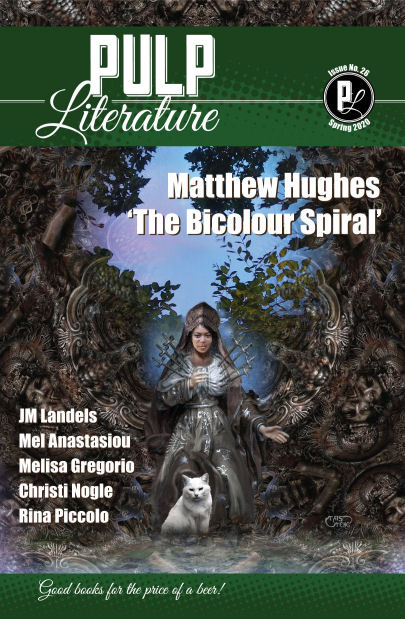
 Spring into Pulp Literature Issue 26 with this week’s feature author, the multi-talented Mel Anastasiou. As a writer, editor, and mentor, she shares her wonderful words and wisdom. But her talents don’t stop there: Mel is also the creator of the incredible line drawings that grace Pulp‘s pages, and of the captivating cover art for Issue 8 and (spoiler alert!) Issue 27, coming soon.
Today, in an excerpt from Part 4 of the Monument Studios Mysteries The Extra, Vancouver schoolteacher and hopeful actress Frankie Ray and her friend Connie Mooney dance their way to danger and mystery at Paradise Villas, a community of extras led by the powerful Loretta Desirée, veteran of King Samson’s epic movies and queen of the extras.
The Extra:
Frankie Ray at the Gates of Monument Studios
by Mel Anastasiou
April 1934
Paradise Garden Villas, Sunset Boulevard
Hollywood
Frankie Ray and Connie Mooney stepped into the crowded courtyard area at the centre of the Paradise Gardens bungalows. Frankie had never seen anything as lovely as the scene before her: warm air, a soft starry sky, and young men and women dancing and laughing in the tiled courtyard amid cottages and palms. Somebody had set up a gramophone, and conga music sounded two large drumbeats, like soft fists against her chest.
In the middle of the courtyard, a small fountain bloomed, with coloured lights reflected in its spray. A couple of dozen young people snaked in a line around the fountain, dancing the conga. One-and-two-and-three. Kick!
She felt Connie grip her arm and hold it for a few syncopated bars, and then some fellow reached out of the cluster of dancers and dragged Connie away. Frankie was left alone on the sidelines. She moved a little to the music, wanting more than anything in the world at that moment to be dancing too but feeling just as certain that she would never really fit in here — not like Connie, who had already vanished from view on the far side of the fountain.
And then, without quite understanding how, Frankie found herself in the arms of a man she’d never seen before. She was smoothly integrated into the snaking line of dancers. One-and-two-and-three. Kick!
She lost sight of the first man almost immediately, but it didn’t seem to matter as she danced across the courtyard and around the fountain, her arms on somebody’s shoulders and another pair of hands clasped around her waist. She looked over her shoulder, but all she could see of Connie — if it was Connie at all — was a flash of copper hair.
And now they were all circling the fountain in the centre of the courtyard, where music drowned out the splash of water. She looked about for the gramophone and spotted it on a table beside an old lady dressed in black and seated in a wicker chair. The old lady’s hands lay clasped across the bosom of her black dress, and her eyes were shut. Electrical cords snaked from the phonograph around a stack of records at her feet.
Around the fountain — one-and-two-and-three. Kick! — the drumbeats pushed at Frankie, and she pushed back. The line ducked under a swinging row of Chinese lanterns.
A young man’s voice shouted in her ear from behind. “Tell me, sister, what brings you to Paradise Gardens?
“We want to live here. We’re actresses,” she shouted back.
He laughed and called out, “The new girls are actresses.”
The line returned a ragged shout, and Tom called, “Who ain’t, darling?”
They conga-ed around the old woman’s chair. Somebody turned up the sound. Clarinets blared, and Frankie could almost see the music, as if it were written by hand across the roofs of the little villas, the notes shining as they rose to join the stars in the deepening sky.
She stumbled on a loose brick and hung on tighter to the shoulders of the fellow in front of her.
Tom danced across the line, took her hands, and put them around his slender middle. He broke her free from the fellow behind her then spiralled her in and out, around and through the conga line, so that she hunched as she danced under the hands that made the chain. Once — twice! — a kick landed on her rear end, so she learned very quickly how to duck and dodge among the dancers. The sky spun overhead, and the bricks tripped her from underneath. Never in her life had Frankie been quite so happy or so homesick. This place, with its laughter and unreasoning welcome, with its heaving dancers under starry skies, with its flowers and firecrackers and Chinese lanterns, made her feel sorry for her old home the way she’d feel sorry for a poor cousin wearing brown at a wedding.
The music switched to a jazz ballad, and the line broke up into smaller, chattering groups.
“There she is.” Tom cocked his head at the old woman next to the gramophone. “The landlady. I told her you helped me get a great quote from Gilbert Howard.”
Meeting the landlady of Paradise Gardens seemed to Frankie to be another of those moments in life that resembled dancing the Carioca: you didn’t want to get off on the wrong foot. Nevertheless, she tripped over the snarled extension cords and knocked the stack of records sideways so that they splayed across the old woman’s feet. Frankie bent and shoved them back under the gramophone, conscious of the landlady’s stare.
To find out what happens next, pick up your copy of Issue 26, Spring 2020 here!
 Mel Anastasiou writes mysteries, including the Fairmount Manor Mysteries and the Hertfordshire Pub Mysteries. For her novel Stella Ryman and the Fairmount Manor Mysteries, Mel won a Literary Titan Gold Book Award and was longlisted for the Leacock Memorial Medal for Humour. As well, she is the author of two illustrated writing guides for Pulp Literature Press. Follow her at MelAnastasiou.wordpress.com and on twitter @melanastasiou.
Discover more from PULP Literature
Subscribe to get the latest posts sent to your email.
Leave a Reply